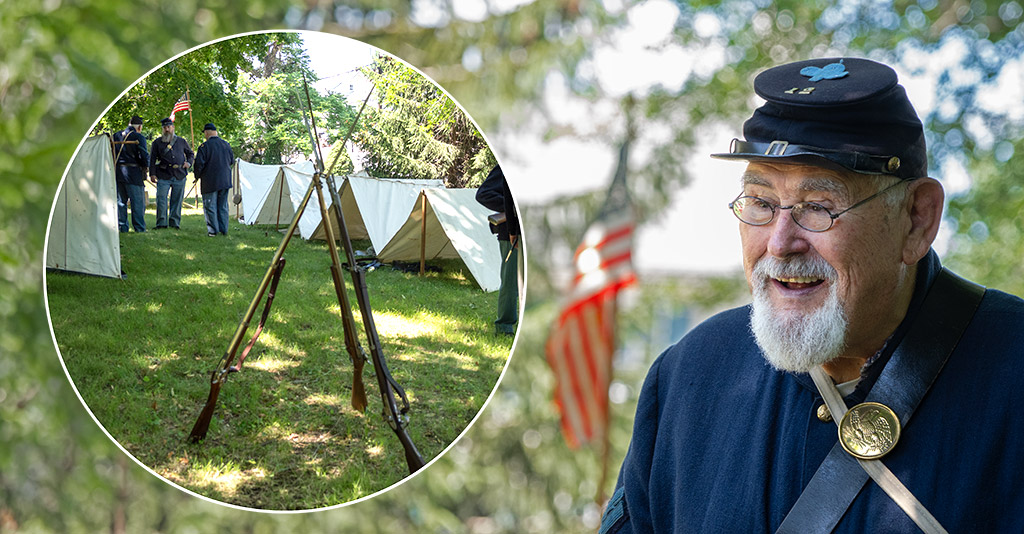
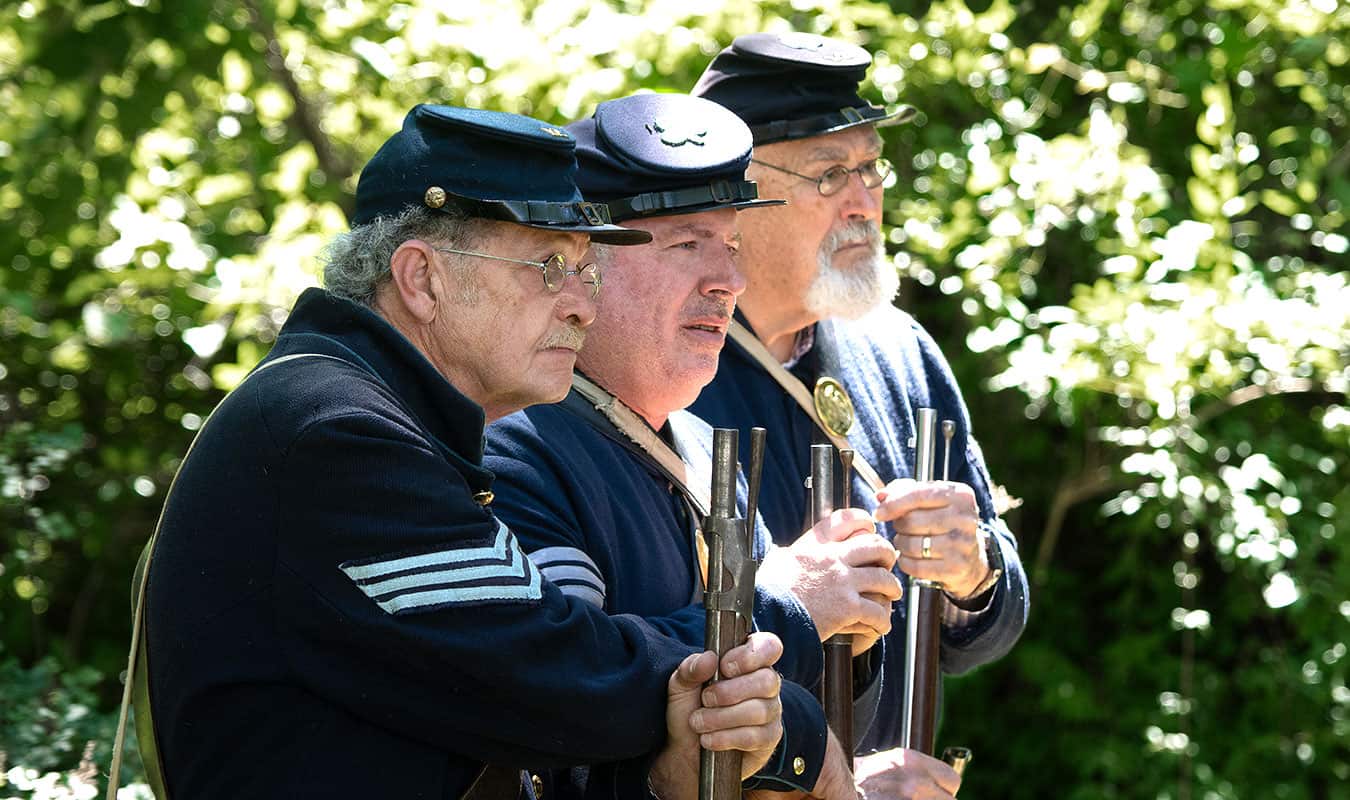
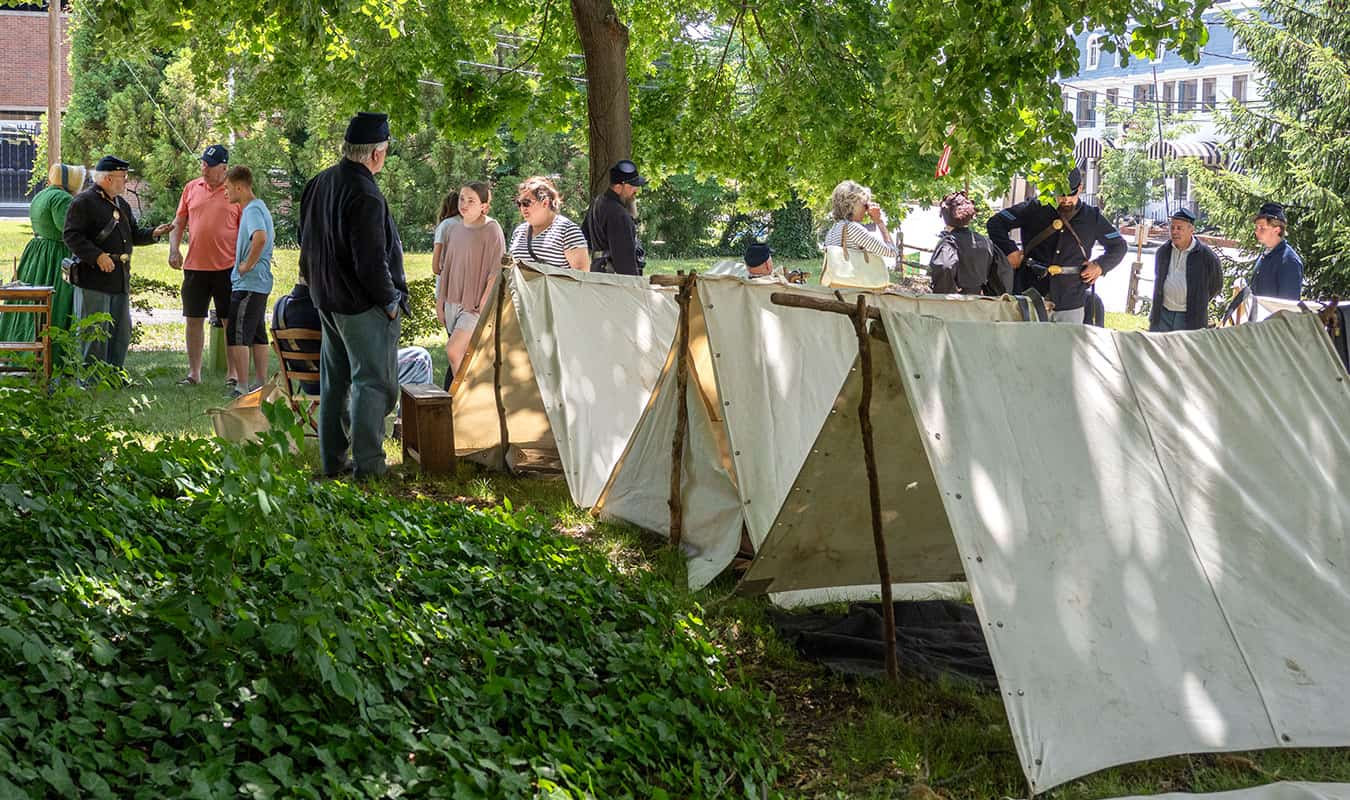
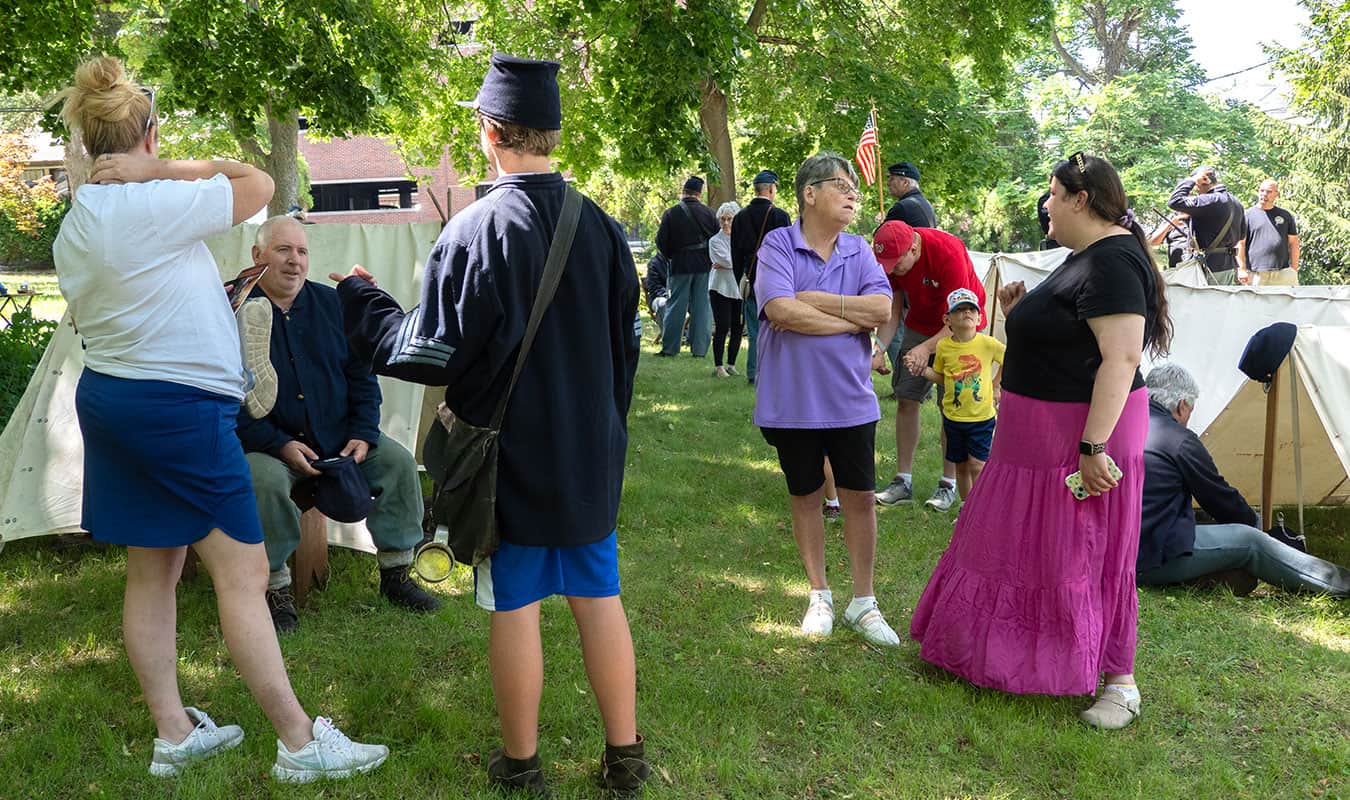
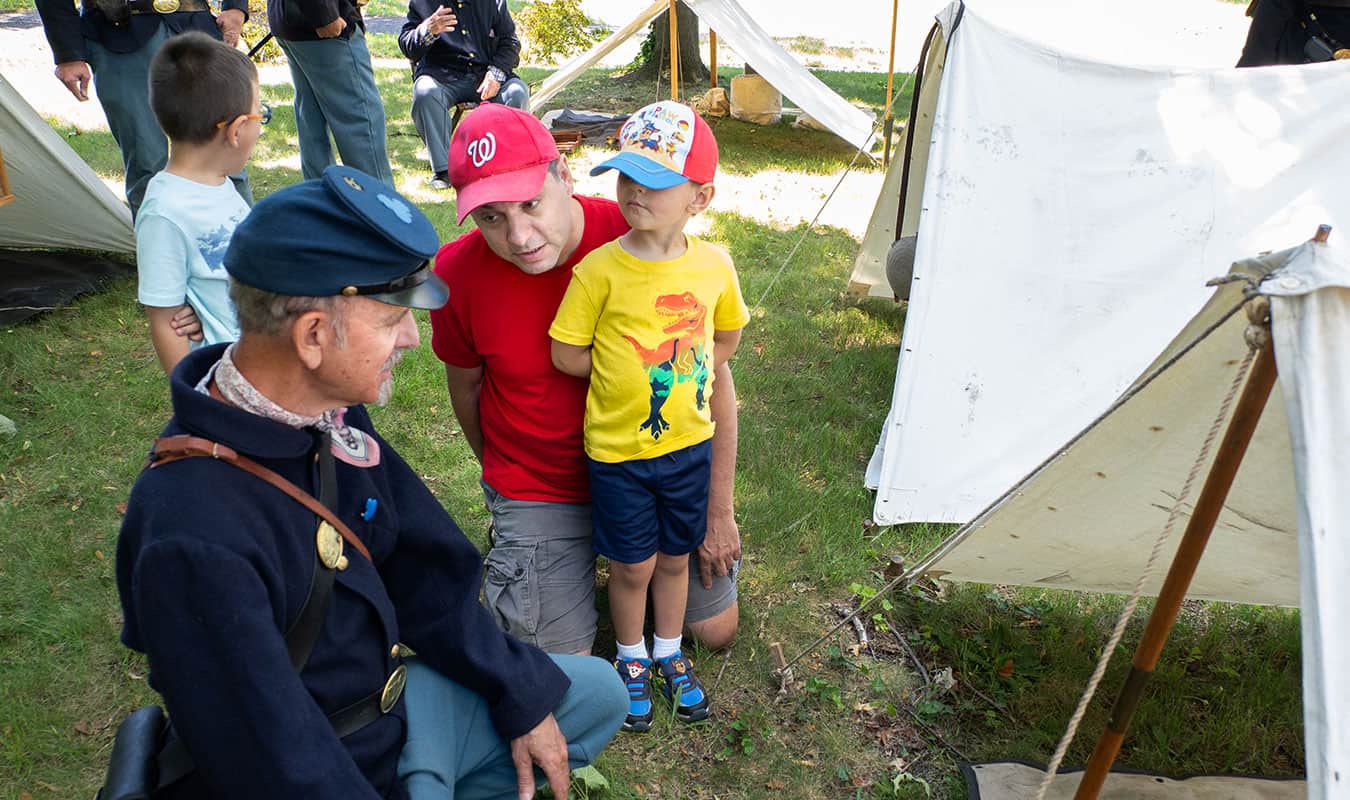
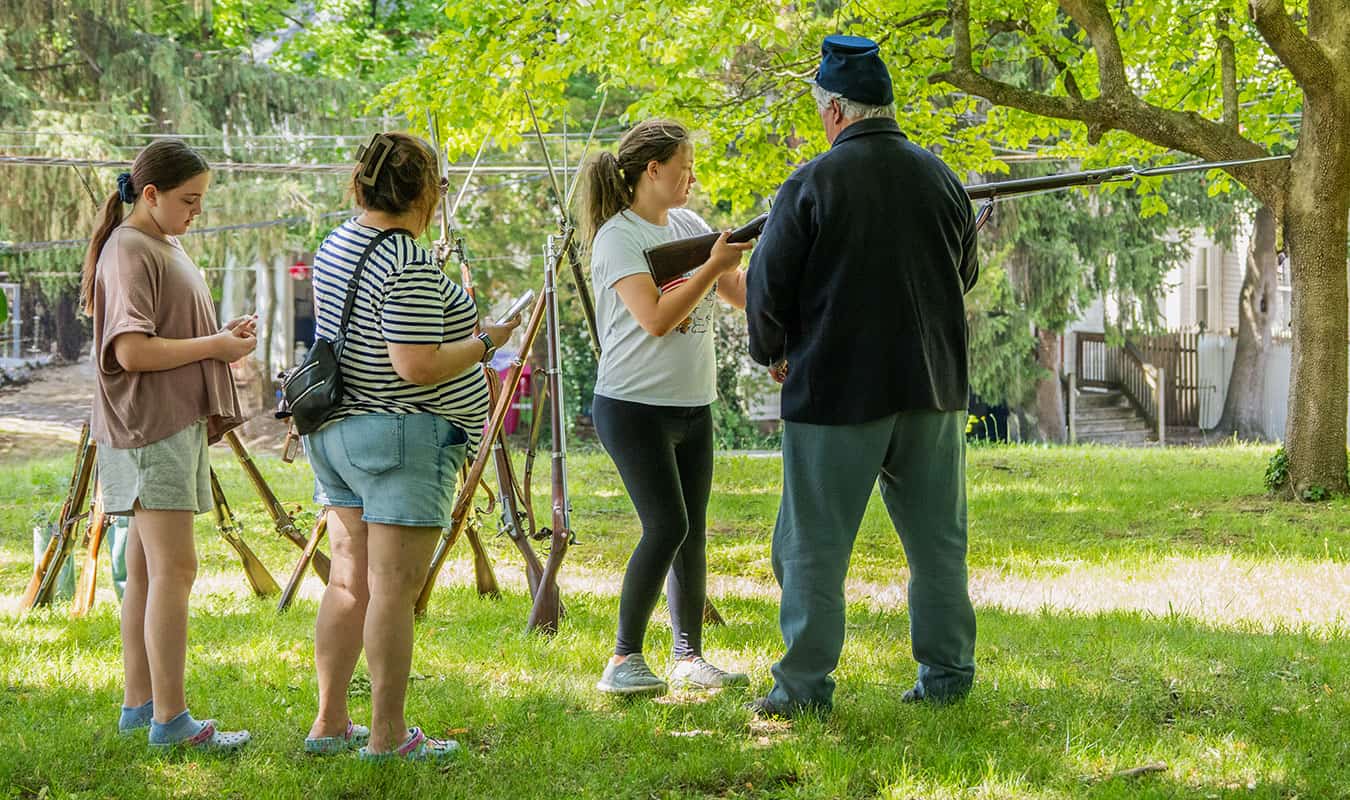
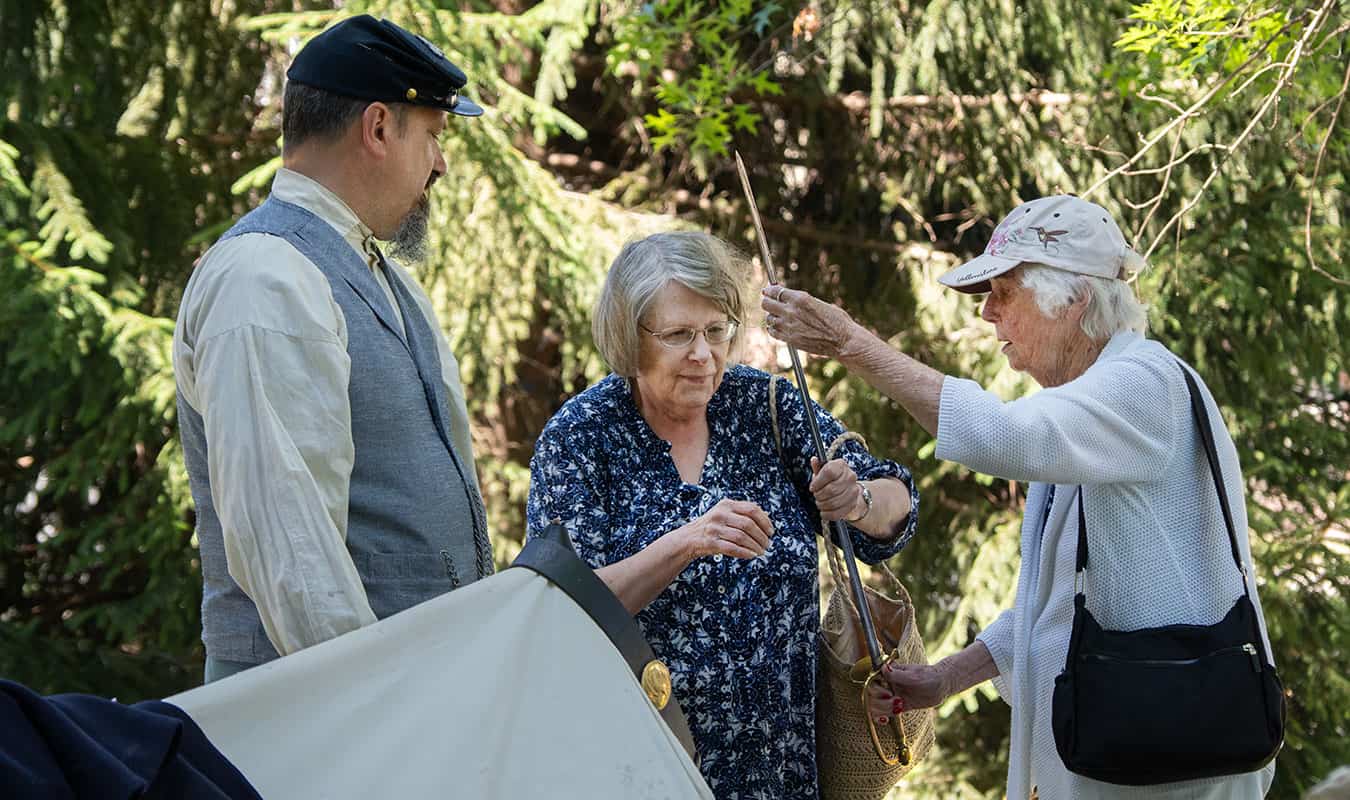
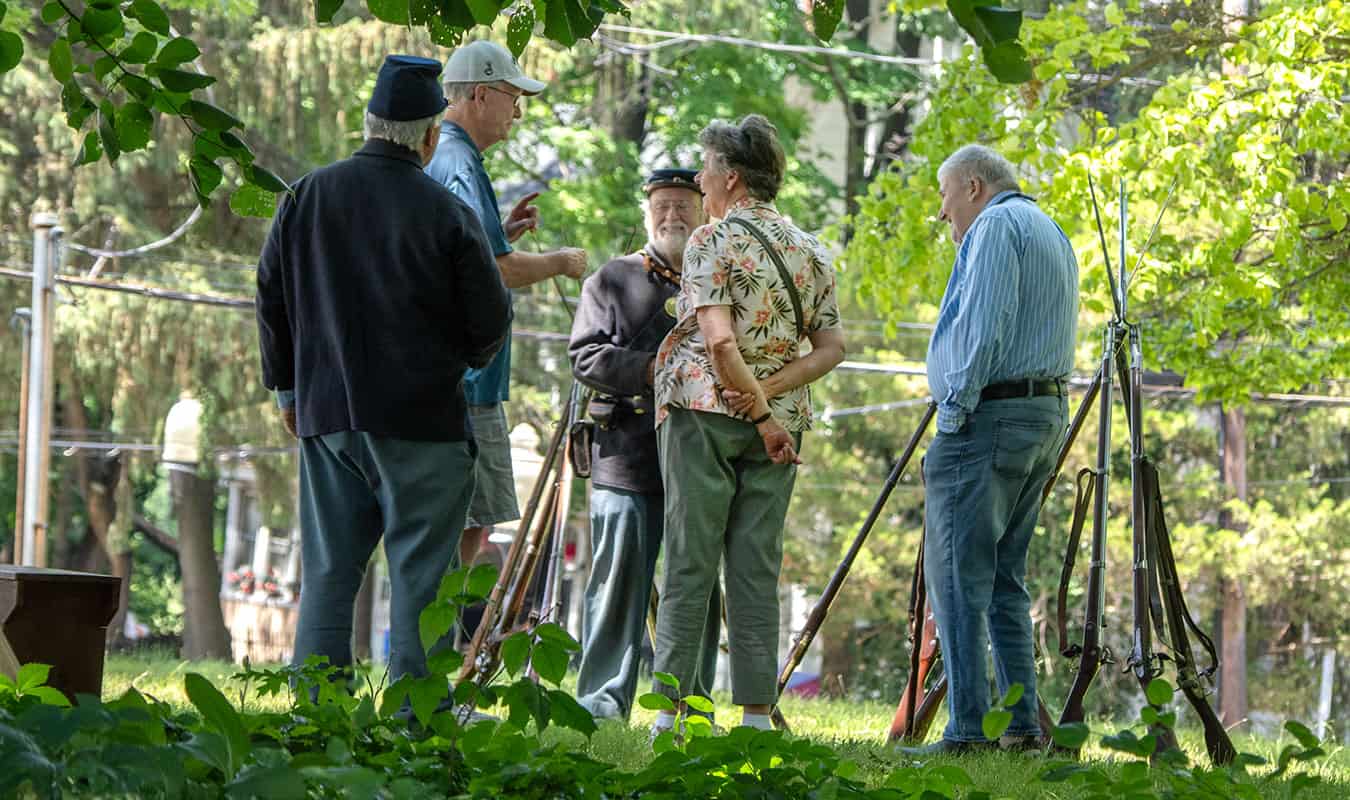
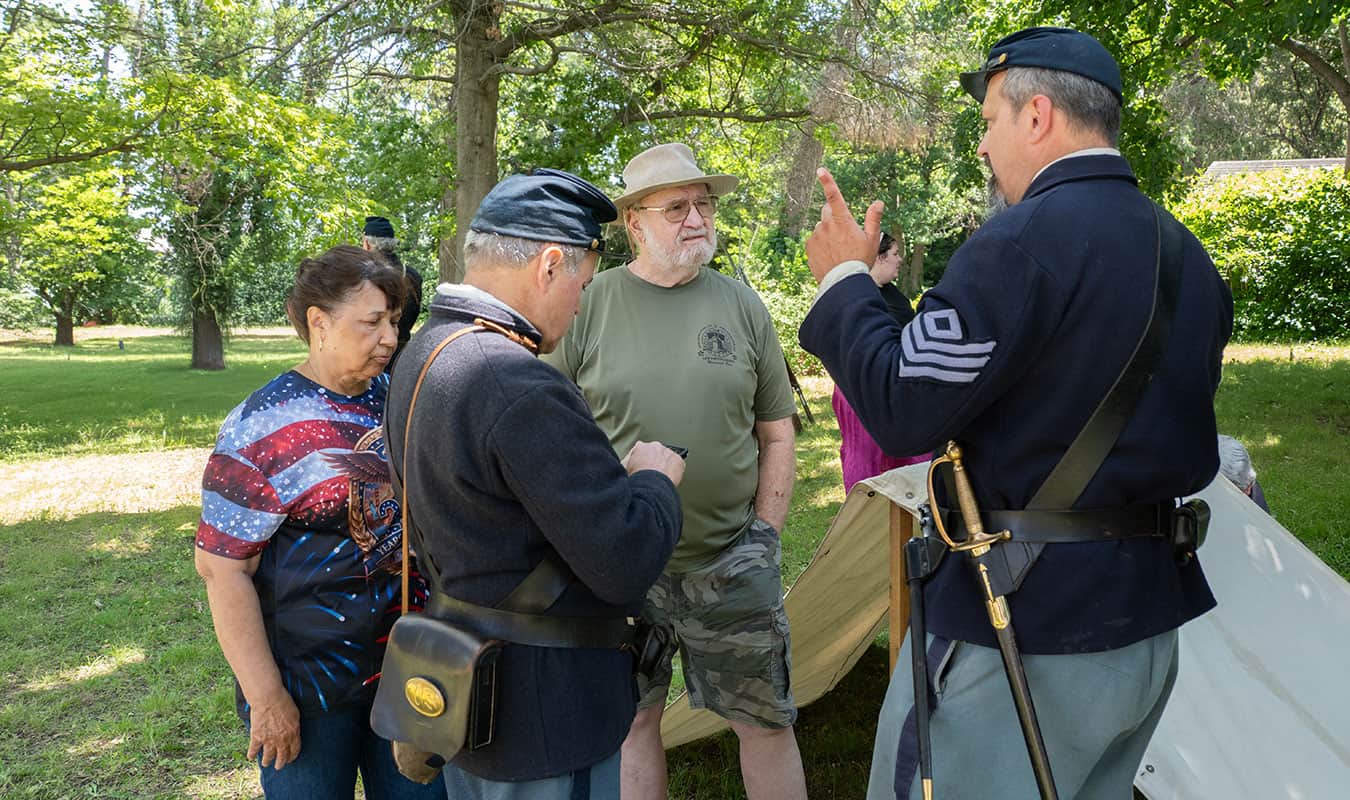
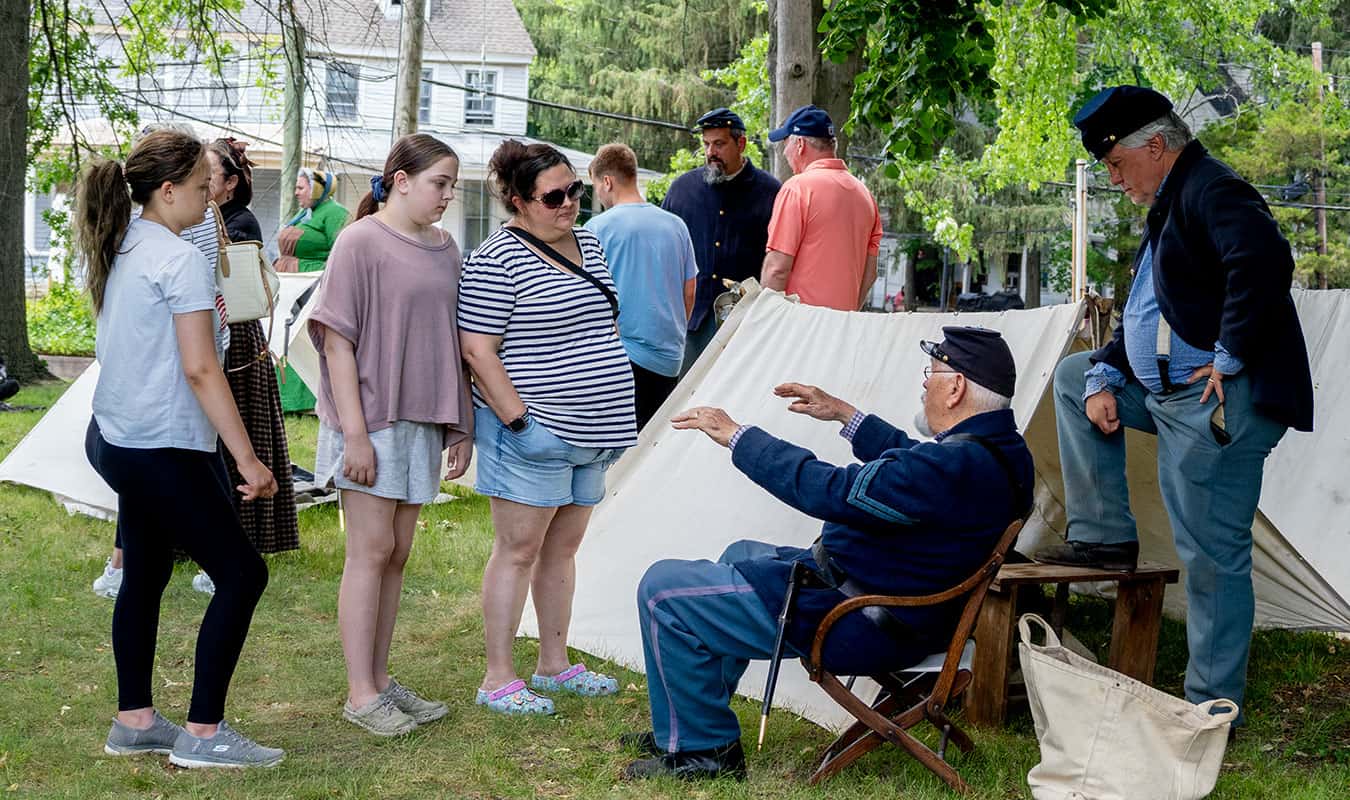
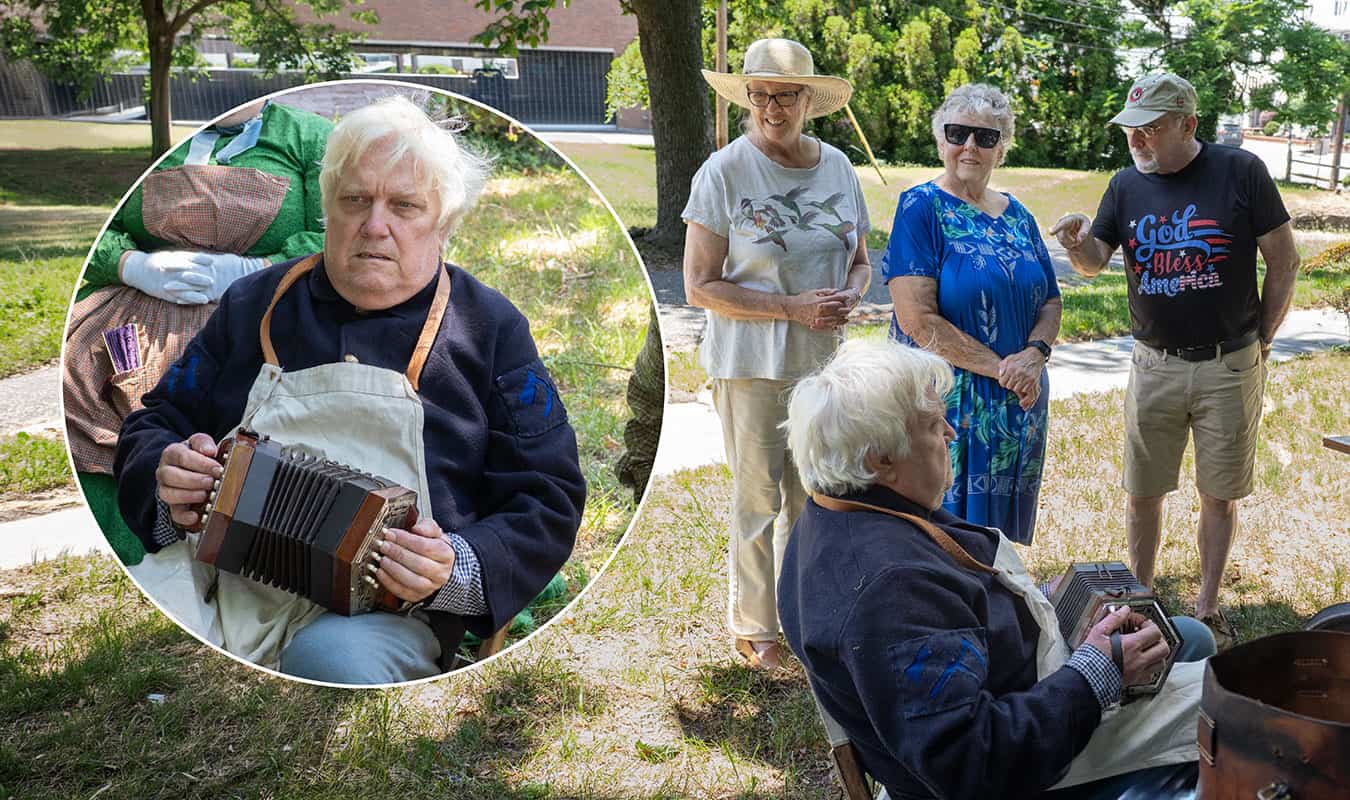
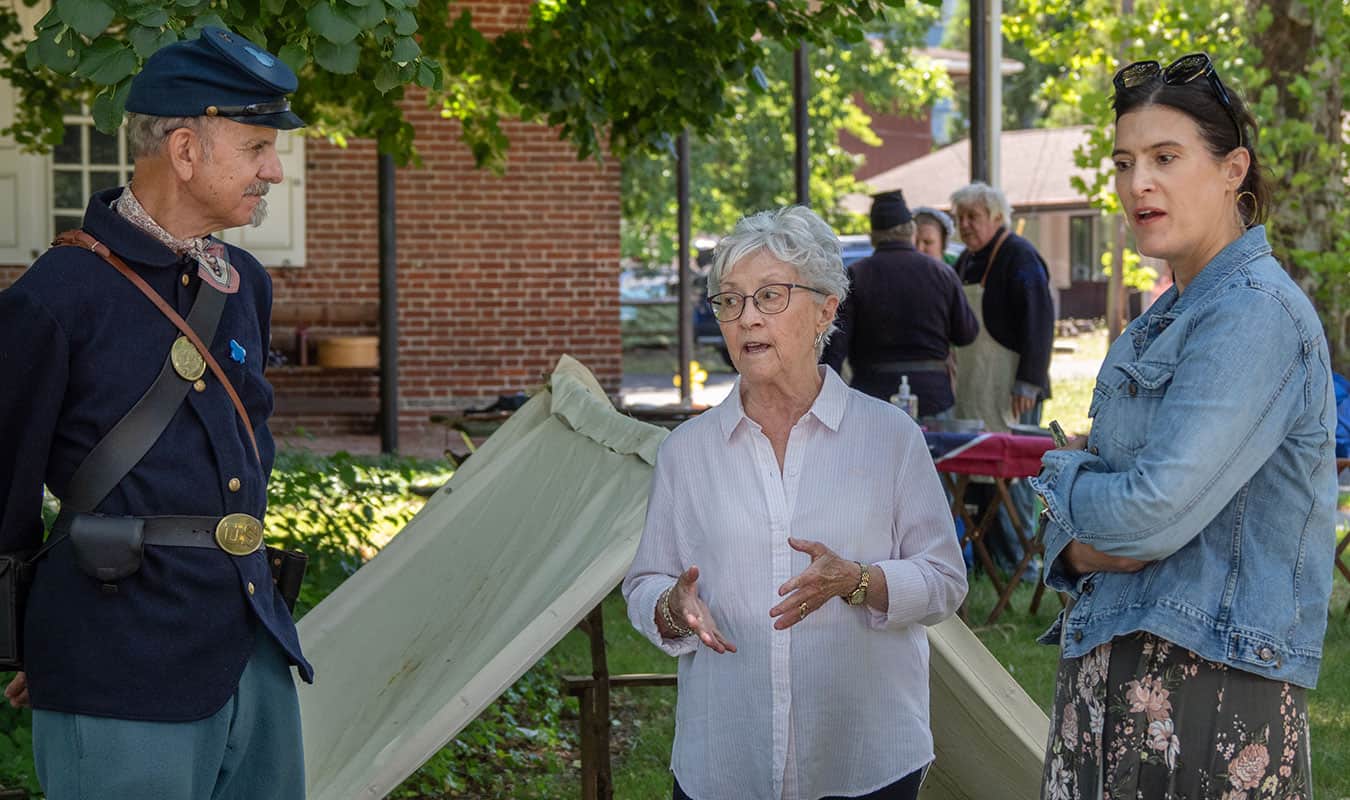
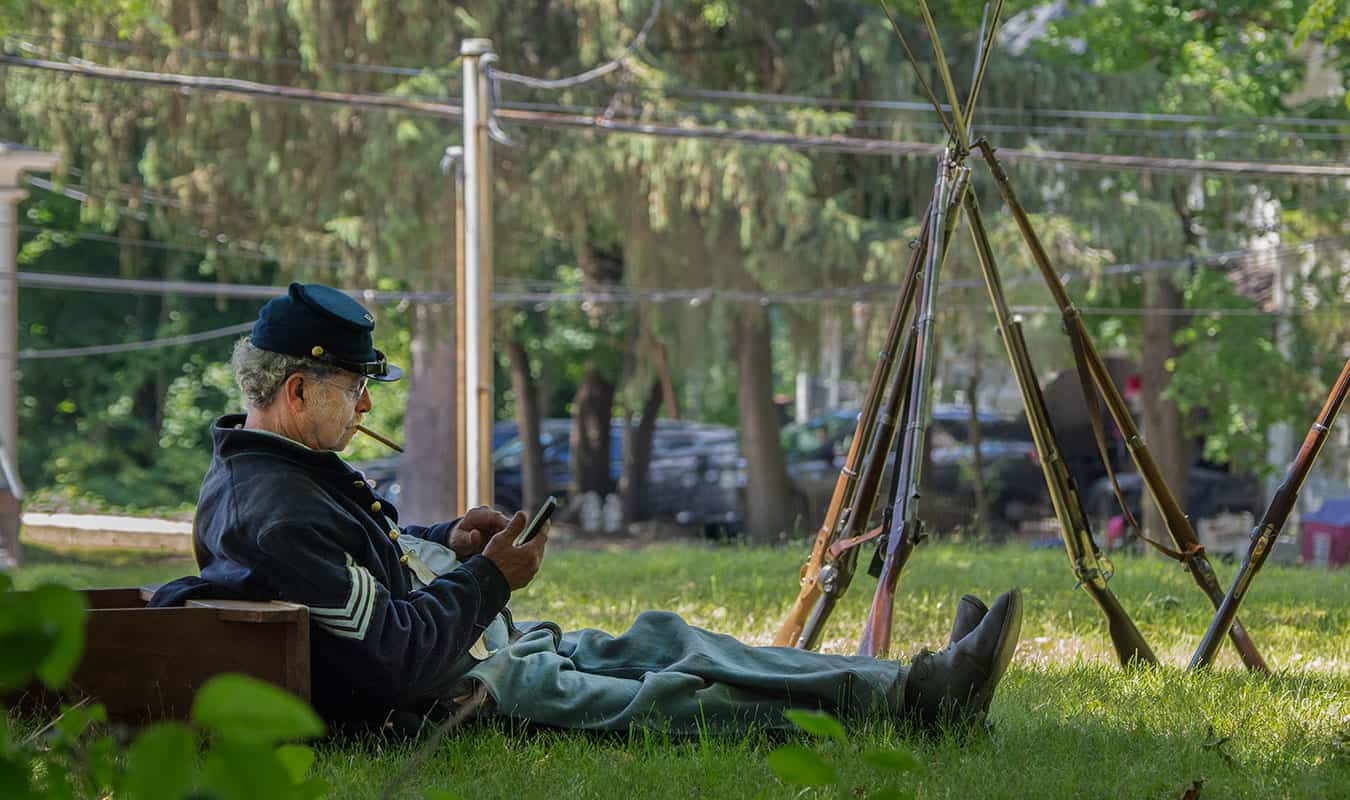
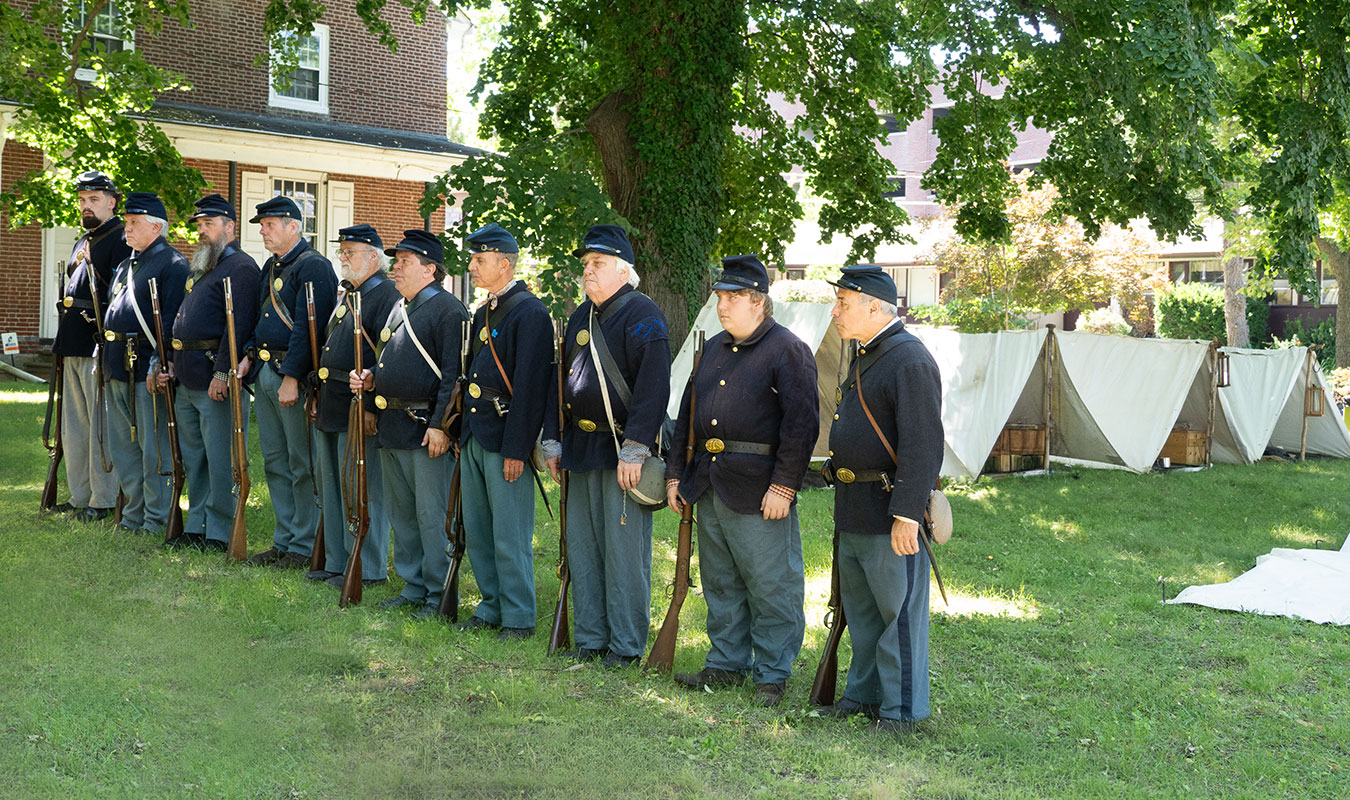
Reenactors of Company K, 12th New Jersey Infantry gathered on the grounds of the Woodbury Friends Meetinghouse on June 19 to create a Union Army Civil War encampment event sponsored by the Gloucester County Historical Society. (Photos: Hoag Levins)
It was a brilliantly sunny day for a demonstration of honor and rememberance at the Gloucester County Historical Society’s Civil War Encampment on June 19th on the heavily wooded grounds of the Woodbury Friends Meetinghouse. The event celebrated the work of the reenactors who keep alive the memory of the volunteers who served in Company K of the Union Army’s 12th New Jersey infantry Regiment during the Civil War.
While it is one of many Civil War reenactor groups in the region, the 12th New Jersey is special because of the important role the regiment played in the Battle of Gettysburg. That three-day clash in central Pennsylvania crippled the Confederate Army’s offensive capability and produced a dramatic Union victory that had a profound psychological and operational impact on the course of the war.
Special Ammunition Load
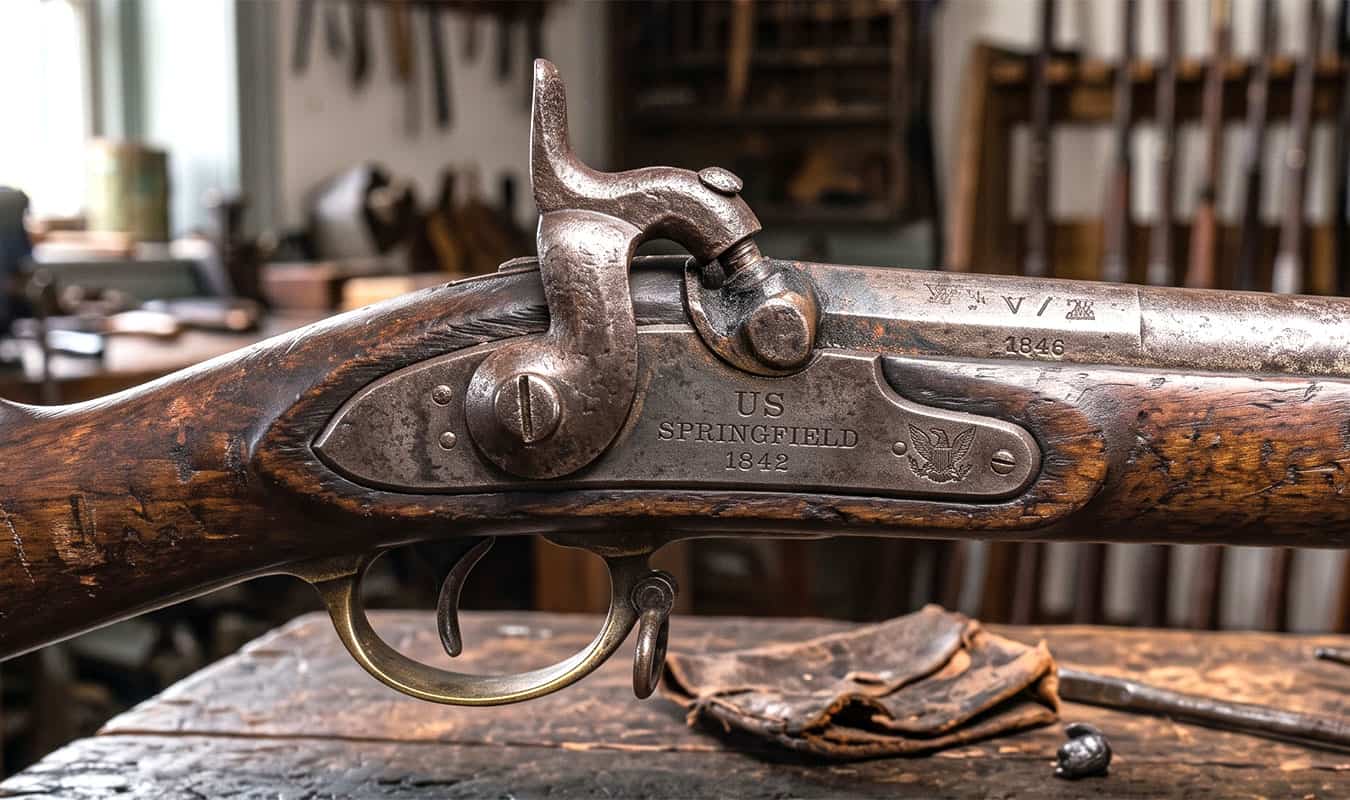
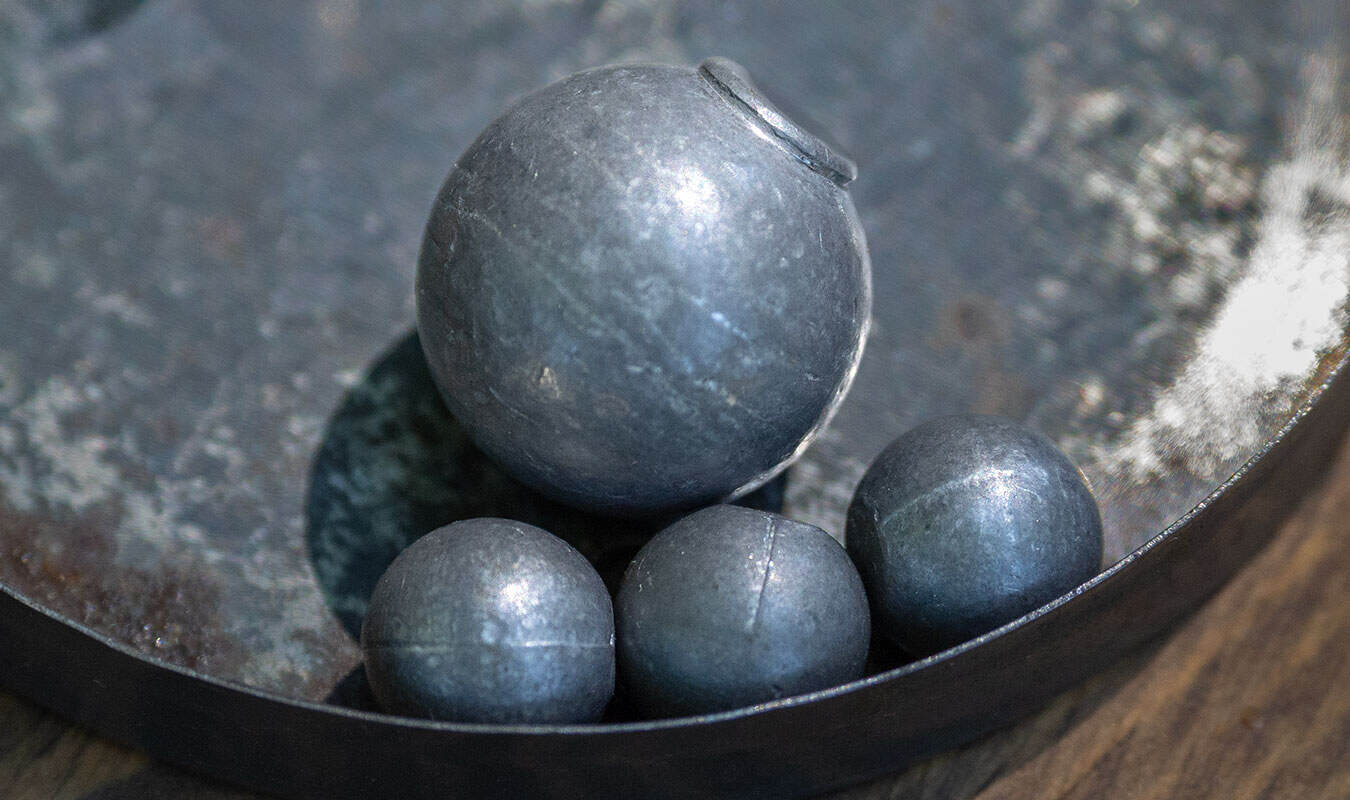
When the conflict began, most soldiers carried smoothbore muskets. By the Battle of Gettysburg, however, roughly four out of five Union infantrymen were armed with modern rifled muskets. The 12th New Jersey was among the minority that still carried .69-caliber smoothbore muskets loaded with buck-and-ball ammunition — a seemingly outdated combination that proved horrifically deadly at close range. Buck and ball consisted of a large musket ball and several buckshot pellets. When fired, the load produced an effect similar to that of a shotgun.
Although it was old at a time when rifled musket barrels were rapidly be adopted by the Union Army, smooth bore musket technology based on the Springfield 1842 design played a major role in critical battles of the Civil War.
While the new rifled muskets fired single bullets more accurately, the smooth bores could load a three-part cartridge consisting of a large ball and three smaller lead buck shots. When fired in close quarters, its effect was that of a shotgun.
On July 3, 1863, the third and final day of the Gettysburg battle, more than 400 soldiers of the 12th New Jersey hunkered behind a low stone wall along Cemetery Ridge. There they loaded their buck-and-ball muskets and held their fire until the mass of charging Confederates was about 50 yards away. Then they unleashed a devastating volley, sending more than 1,500 projectiles traveling at roughly 700 mph into the Confederate ranks and tearing a gap in the advancing line. Reloading as rapidly as possible, the soldiers continued their barrage, helping to break the cohesion and momentum of the Confederate left flank.
Inflicted Staggering Casualties
Their stand contributed to the staggering casualties suffered by the attacking Confederates, helping force Gen. Robert E. Lee to retreat back to Virginia and marking a decisive turning point in the war.
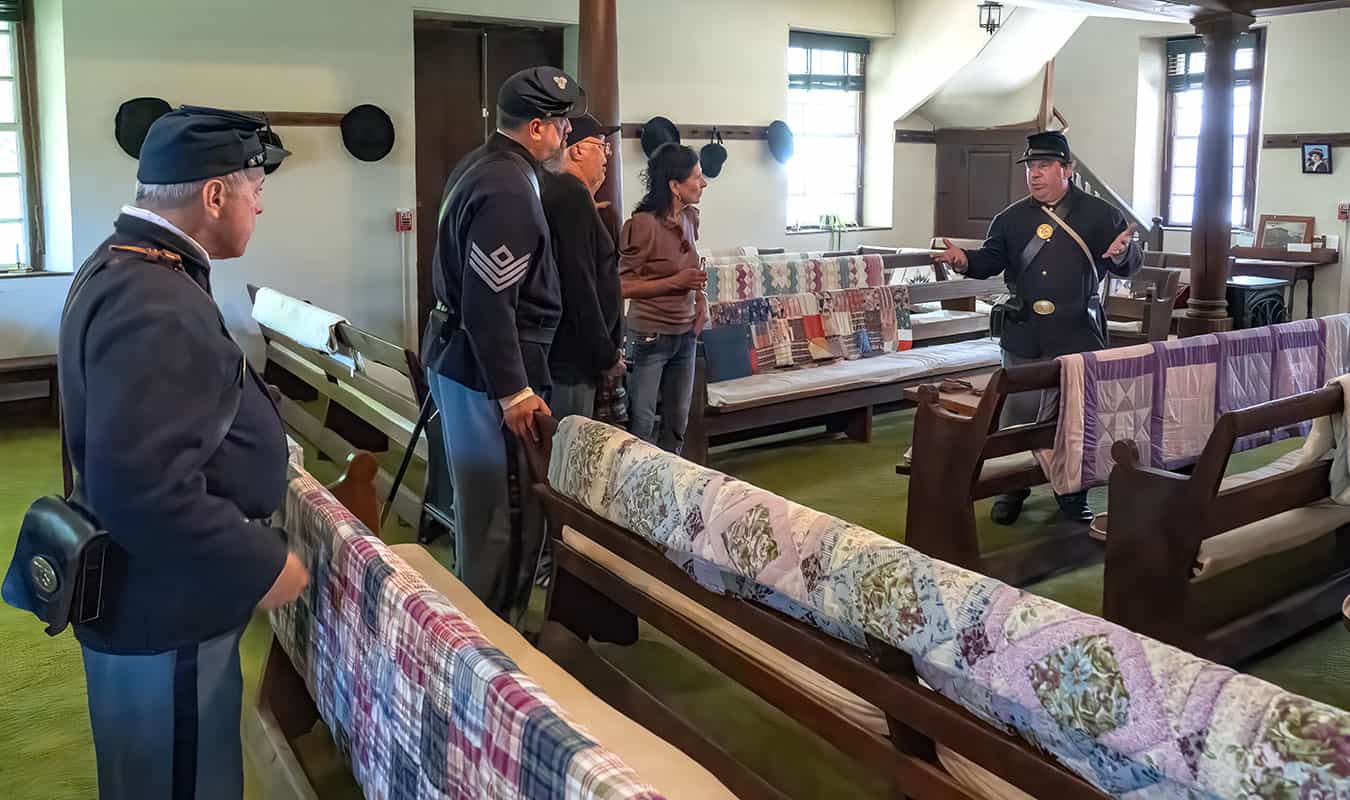
At the encampment, the 12th New Jersey set up tents and displayed their period uniforms, weapons and supplies for a crowd that was interested in all aspects of the Civil War experience. In keeping with the Quaker tradition of the Friends Meetinghouse, no guns were fired during the event. Dietrich Preston, who is both the Clerk of the Woodbury Friends Meetinghouse and a reenactor with the 12th New Jersey, led tours through the 311-year-old massive wooden meetinghouse structure. Photos below show what the event looked like.
As part of their dedication to living history practices as acts of honor and remembrance, reenactors like those in the 12th New Jersey are sticklers for period authentic uniforms, equipment, weapons an gear.
This assembly of crude tents is what an encampment would have looked like for real. Meanwhile, despite the heat of the day, the reenactors maintained their heavy wool uniforms throughout the day.
Dietrich Preston, who is both the Clerk of the Woodbury Friends Meetinghouse and a reenactor with the 12th New Jersey, led tours of the 311-year-old historic Meetinghouse throughout the day.
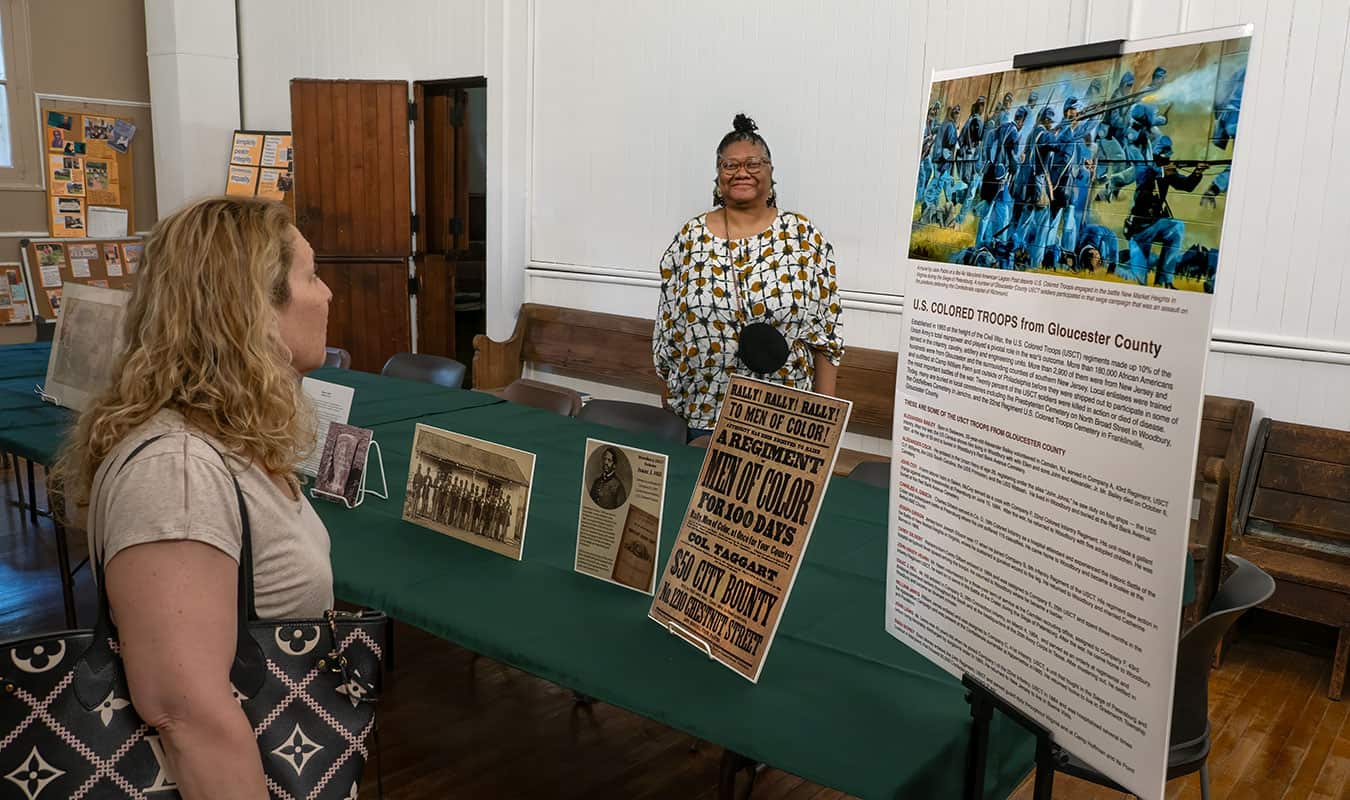
The event also featured a display about the local Gloucester County men who served in the Civil War’s U.S. Colored Troop regiments. In the rear, Woodbury Councilwoman Donna Miller answers a visitor’s question.
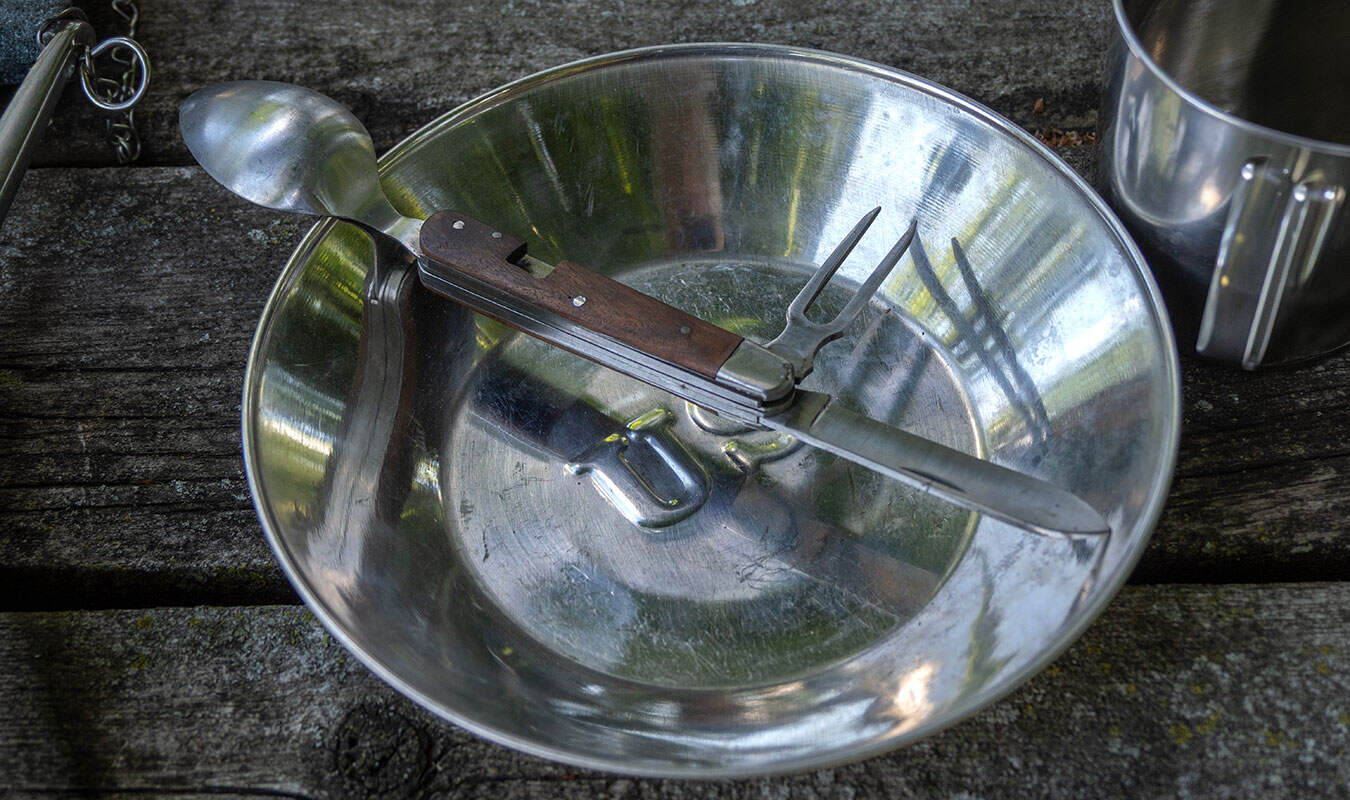
Reenactors typically form small “mess units” within a larger company—groups of four to eight men who camp, cook, cook rations, and march together with reproduction Union Army utensils. The combination pocket knife, folk and spoon were popular personal purchases or gifts received from home among Union soldiers.
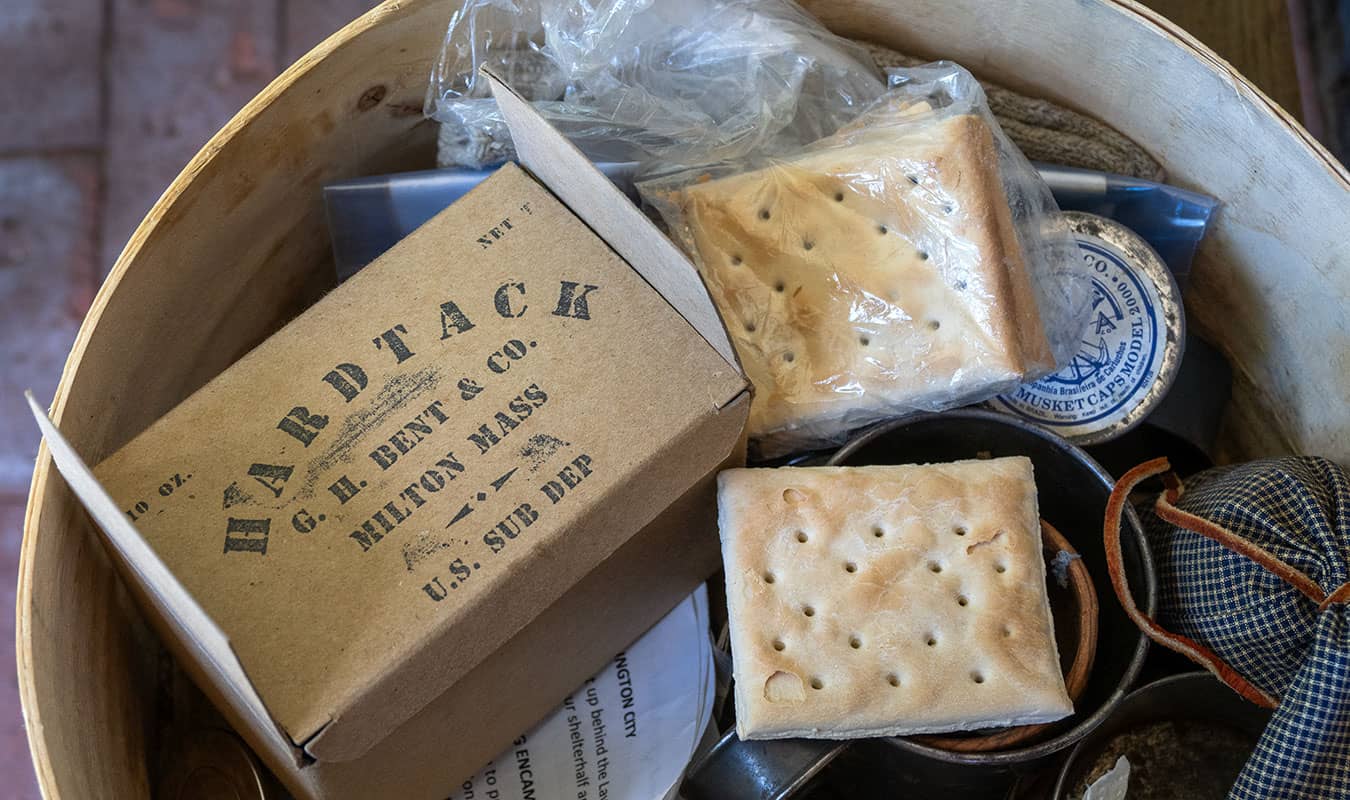
For the average soldier hardtack was both a nutritional lifeline and a daily test of endurance. Made out of flour, water, and salt, it was hard as a rock and could easily fracture a tooth. The most common method of making it eatable was soaking it in hot coffee or smashing it with a gun stock and sprinkling the bits into stews or pork fat pancakes.
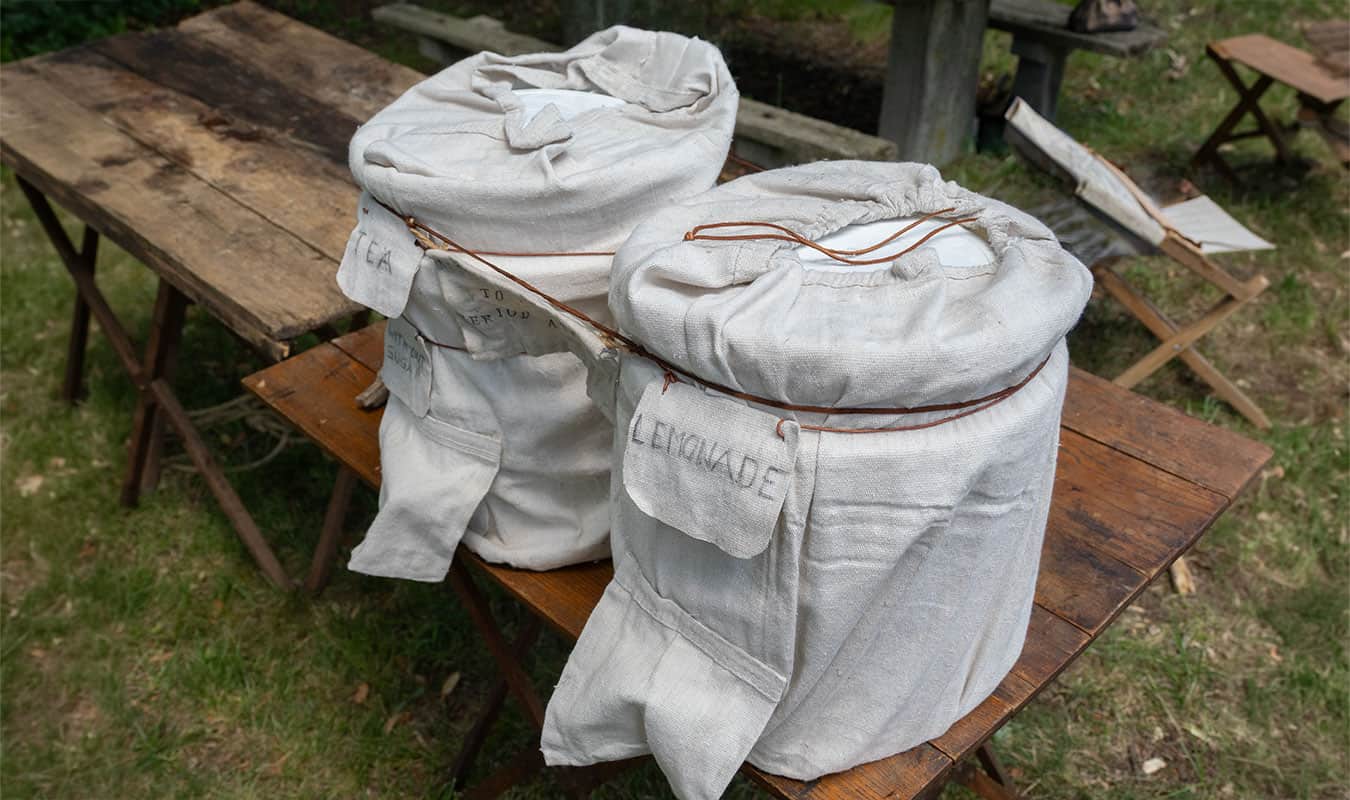
Lemonade was available in authentic ceramic jugs wrapped in scrap canvas sacking. In real life during the war, the sacking would have been kept wet so that the ongoing process of evaporation would cool the ceramic and the lemonade below.
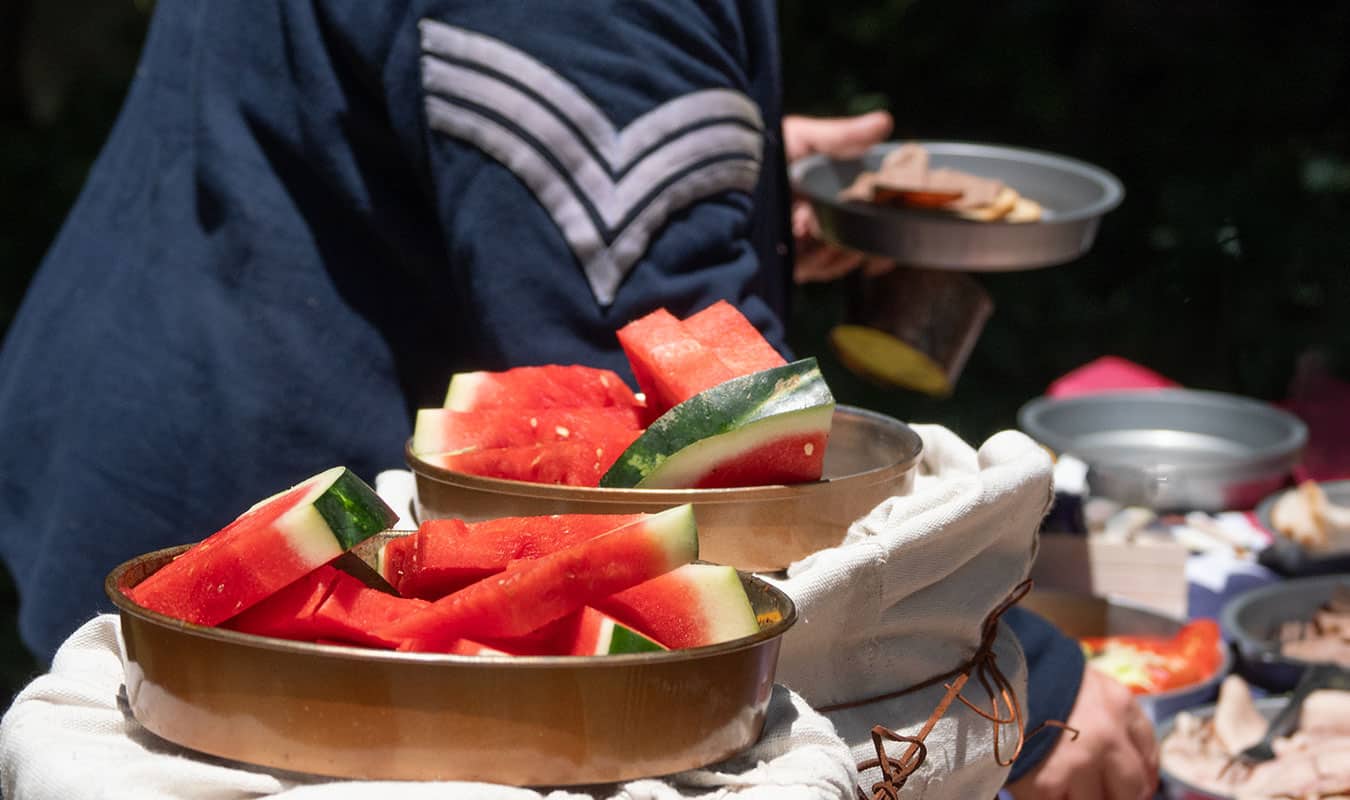
Mess call at the encampment featured period foods and deserts — like fresh sliced watermelon.
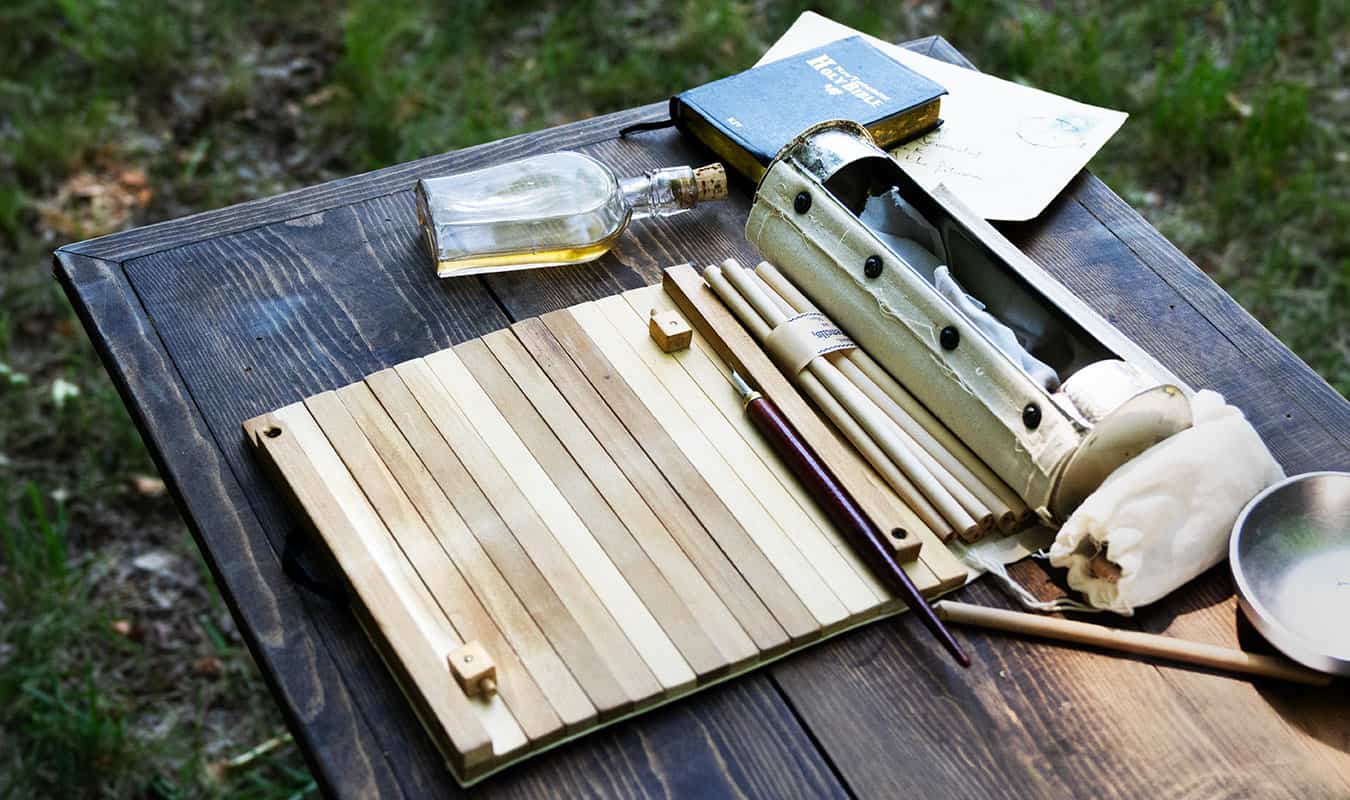
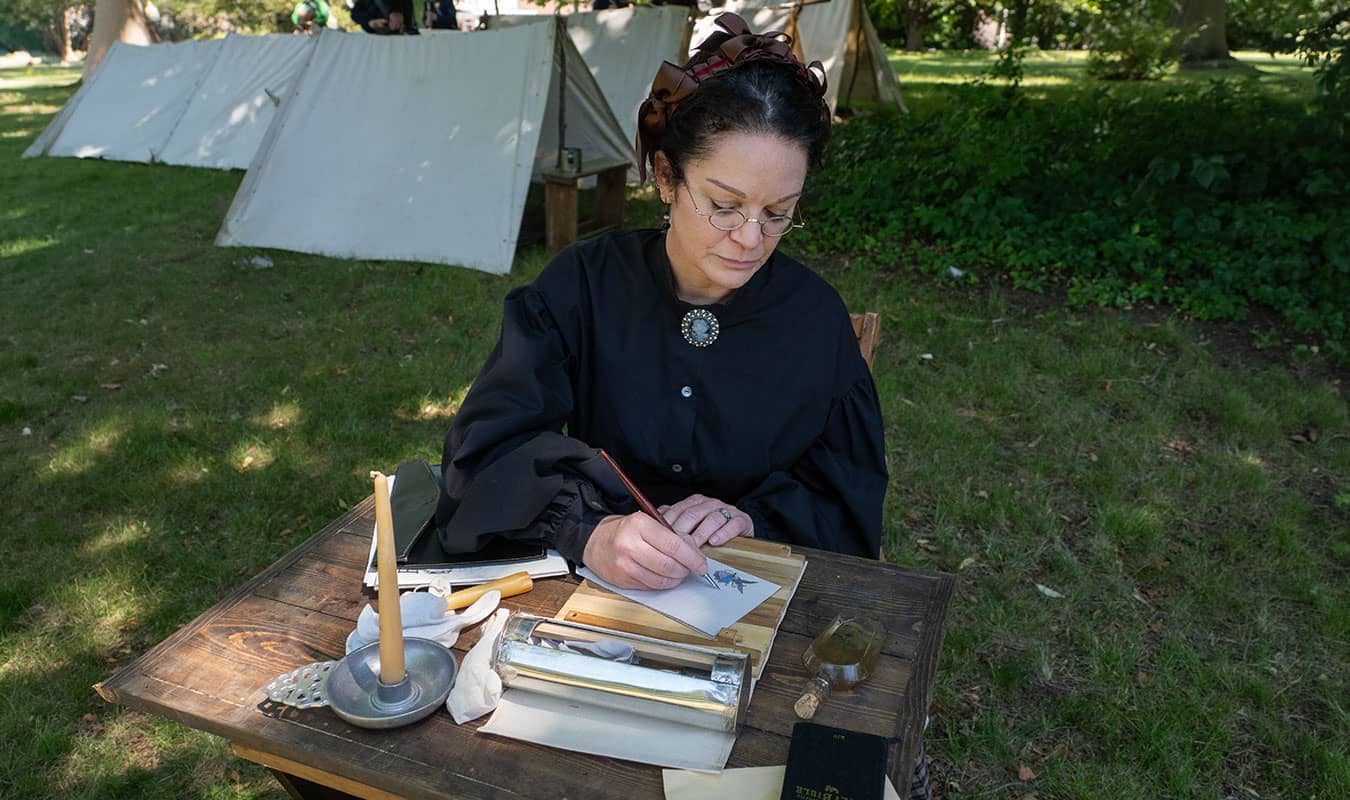
When bivouacked in muddy, rainy or other unfavorable conditions in the wild, writing letters was a challenge for Civil War soldiers. A popular gift from home for them was a writing kit with rolled up slats that could be unrolled and locked into a flat writing surface. A tin cylinder held the device along with a pencil or pen and inkwell.
Tina Neff, whose husband and son are both members of the 12th New Jersey demonstrated how the writing kit worked.
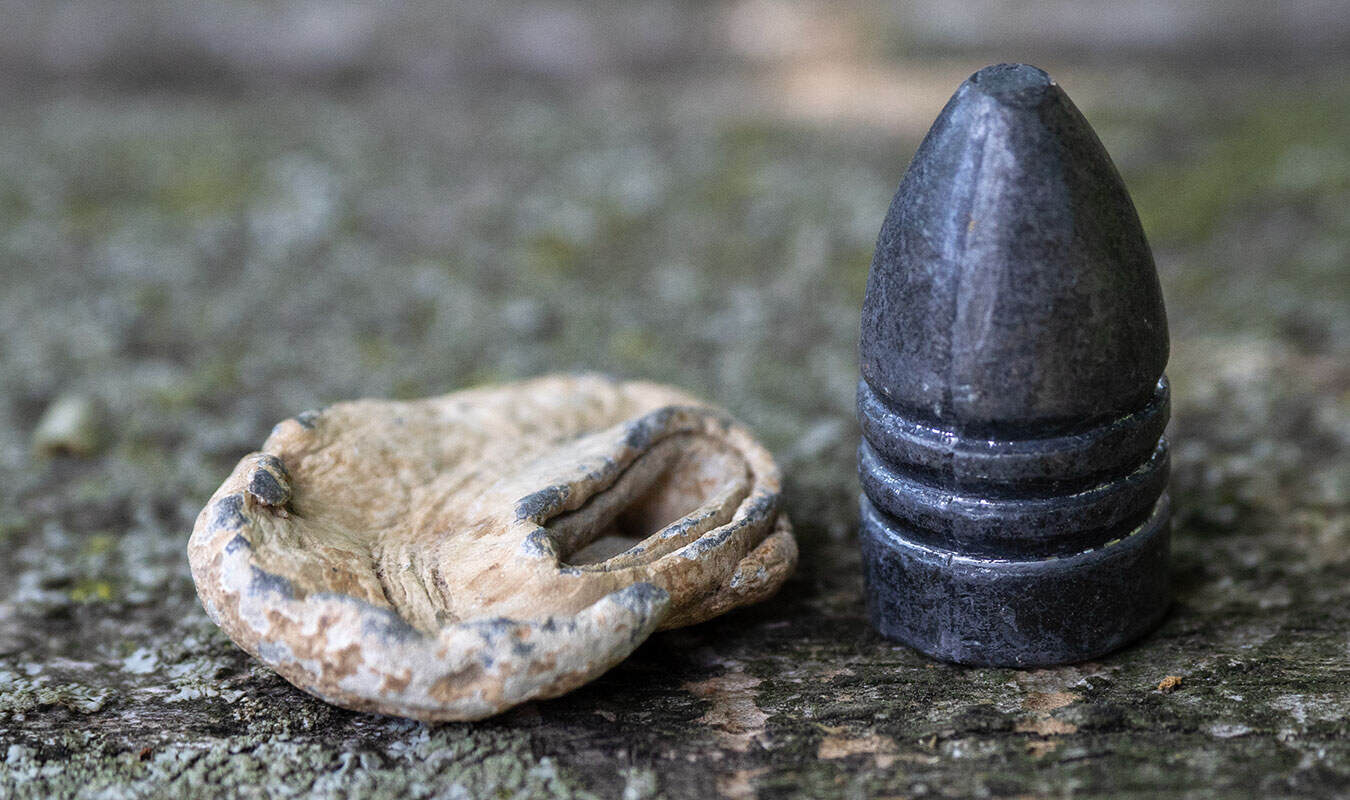
Minié ball ammunition that was used by a majority of Union Army troops wasn’t actually a ball but rather an aerodynamically shaped lead bullet. As part of its display, the encampment explained how minié balls smashed flat as they hit a human body, tearing larger wounds.
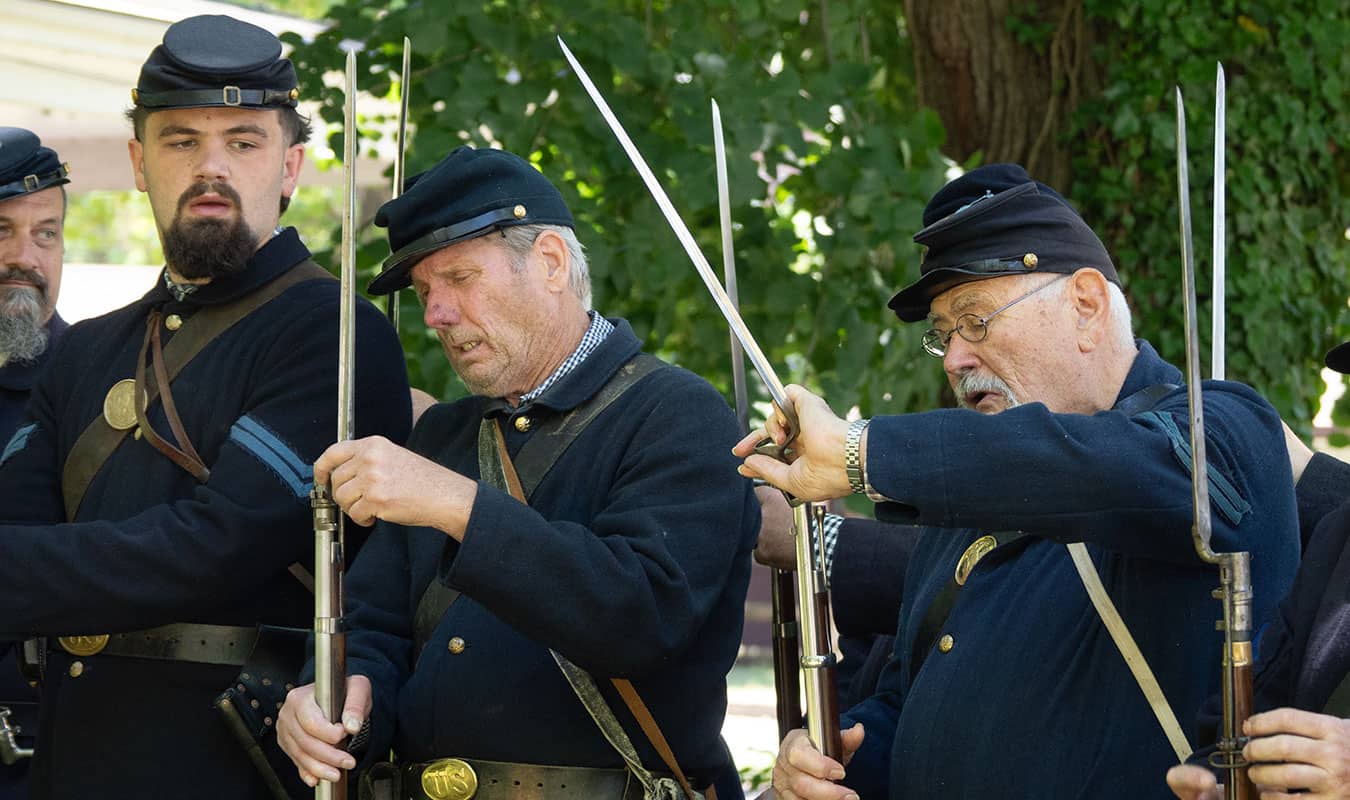
Although every Civil War infantryman carried a bayonet, actual bayonet fighting was surprisingly rare. Historians estimate that less than 1% of the war’s casualties were the result of bayonet wounds. In memoirs, some veterans later noted that just the sight of a line advancing with fixed bayonets was often enough to make an opposing force withdraw.
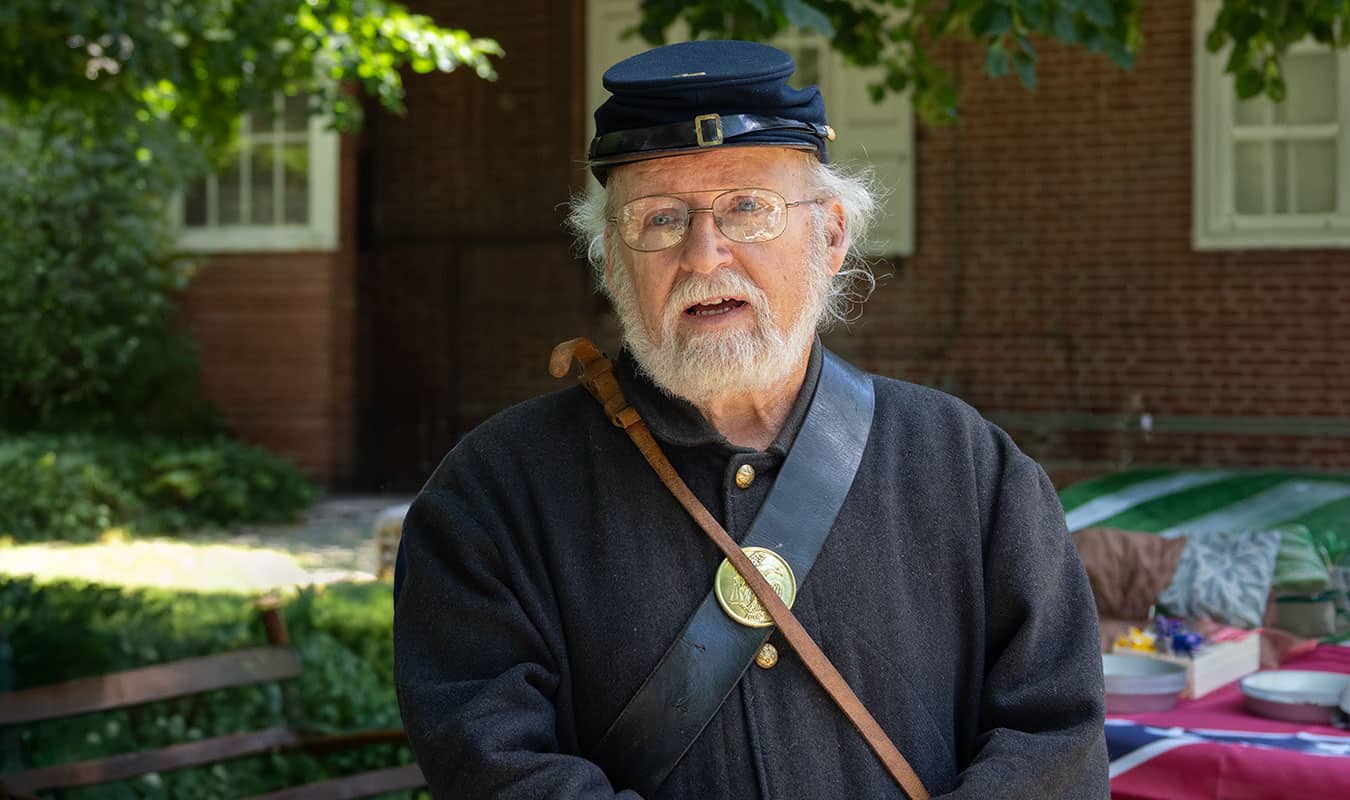
Vince DeCicco, a volunteer who oversees the Gloucester County Historical Society military collection is also a member of the 12th New Jersey and played a major role in organizing the encampment event.
Gloucester County Historical Society Vice President Sandy Levins and Society volunteer Dana Gayeski, a partner in the law firm of Goldberg Segalla, chat with a reenactor about the encampment.